
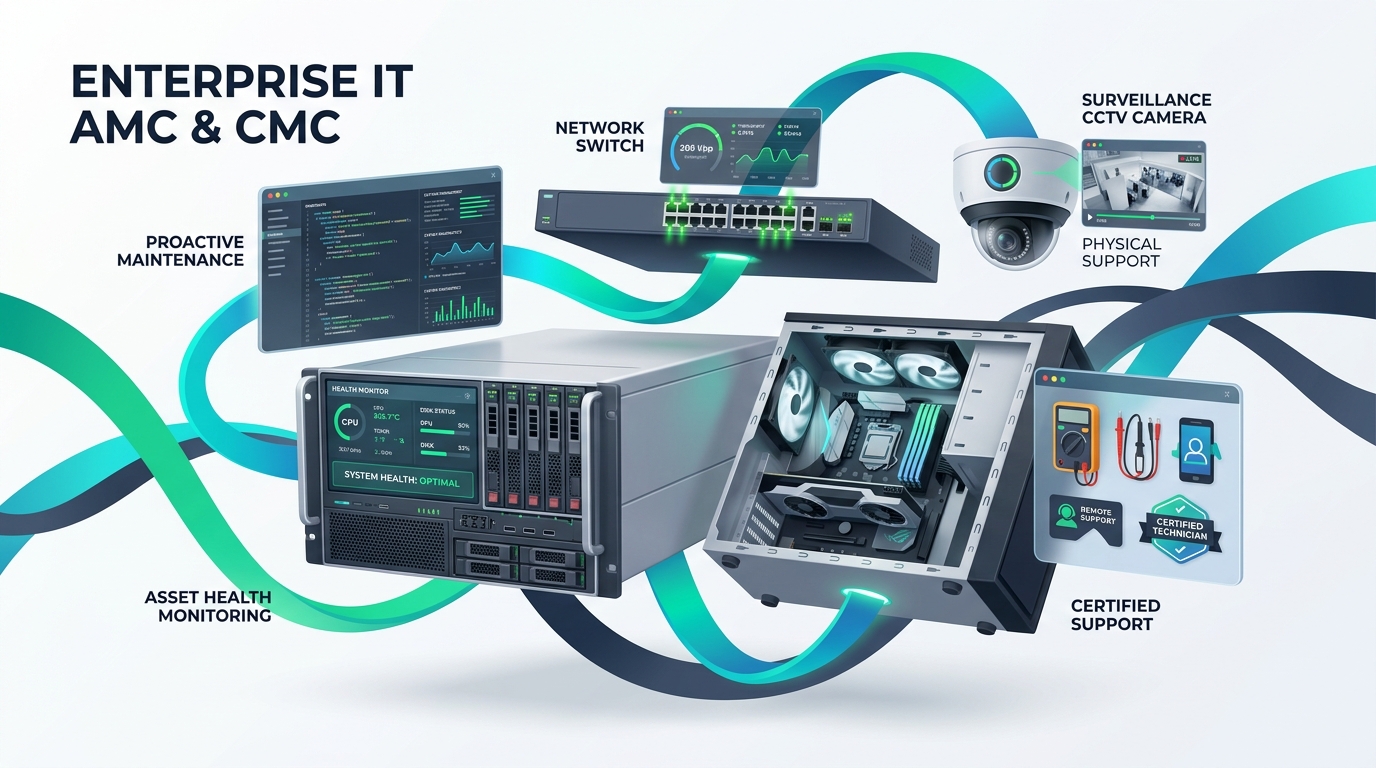
In business operations, downtime is the ultimate productivity killer. Break-fix support is purely reactive: you wait until an on-prem server dies, a ransomware payload encrypts files, or the office Wi-Fi drops before calling a technician. Preventative IT Maintenance with an Annual Maintenance Contract (AMC) identifies failing disk SMART telemetry, thermal spikes, unpatched vulnerabilities, and silent backup failures before they interrupt revenue-generating work.
What is the Break-Fix IT Support Model?
In a conventional break-fix model, an organization engages an IT vendor only after a workstation, network switch, or server experiences a failure. The technician diagnoses the problem on-site and bills for parts plus hourly labor.
While this approach appears superficially cheap for a micro-business with just two or three laptops, it misaligns incentives: the vendor only profits when your systems break down. Furthermore, emergency hourly rates are volatile, replacement parts take days to arrive, and lost staff productivity is never reimbursed.
What is Preventative IT Maintenance?
Preventative IT maintenance is a systematic, scheduled regimen of proactive care designed to maintain system health, patch security flaws, and detect hardware degradation early.
Continuous 24/7 endpoint telemetry monitoring CPU temperatures, SSD write endurance, and unread event logs.
Testing operating system and firmware updates in staging before silently applying them outside business hours.
Direct Model Comparison: Break-Fix vs. Preventative Maintenance
| Operational Dimension | Reactive Break-Fix | Preventative IT Maintenance (AMC) |
|---|---|---|
| Incident Timing | Uncontrolled emergency during peak business hours | Planned maintenance scheduled during off-peak windows |
| Budget Predictability | Unpredictable spikes; costly emergency hourly invoices | Fixed, predictable monthly/annual operational expense |
| System Visibility | Blind until a component catches fire or crashes | Comprehensive asset inventory with health metrics |
| Response SLA | Best effort (often 24 to 72 hours wait time) | Contractual 2-hour or 4-hour SLA guarantee |
Calculating the True Financial Cost of a Workplace Outage
When estimating the damage of IT downtime, executives often look only at the hardware repair invoice. However, the true financial cost is calculated as:
For a 50-person enterprise with an average loaded labor cost of $35/hour, a 4-hour server or network outage costs $7,000 in lost payroll alone — before counting missed client deadlines or reputation damage.
Core Pillars: Patching, Backups, Health & Security
Building an AMC Plan Tailored to Your Workplace
- Complete Hardware Discovery: Inventory all laptops, desktops, managed switches, firewalls, and NAS storage units.
- Classify Mission-Critical Tiers: Establish Tier-1 (ERP, internet gateway, finance) with 2-hour response, and Tier-2 (workstations) with next-business-day response.
- Deploy Centralized RMM Agent: Install unified remote monitoring and management (RMM) software for real-time telemetry.
- Formalize Standard Operating Procedures (SOPs): Document escalation paths, backup protocols, and emergency loaner laptop provisions.
Measuring Operational Resilience KPIs
Mean Time to Resolution for high-priority operational tickets.
Zero unverified or failing nightly snapshot jobs across cloud and on-prem NAS.
All patching and hardware replacements executed in designated maintenance windows.

Providing comprehensive Annual Maintenance Contracts (AMC), corporate network engineering, workstation health monitoring, and on-site SLA support for enterprises since 2012.